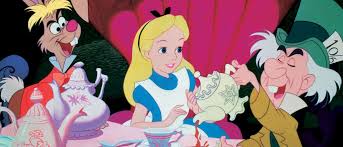
“We’re All Mad Here.” “Curiouser and Curiouser Indeed!”

“It’s no use going back to yesterday, because I was a different person then.”  Alice, realizing how her perspective has changed.

I have always been obsessed with Alice in Wonderland. When I was a kid, I loved it for the wonderful and cooky characters. The Cheshire Cat, the Caterpillar with his vowels, Tweedledee and Tweedledum, The Queen of Hearts and of course the inimitable Mad Hatter. I will admit the white rabbit held a special place in my heart as he rushed about going nowhere.

I have often related to that effort so many times in my life.

The tea party, the mushrooms and all the other craziness Alice endured on her journey seemed like a fun story in a crazy place.

Of course as I grew older, I realized the metaphor for the journey into adulthood, but I chose to ignore that truth. I prefer to think of wonderland as a place filled with funny creatures, tea cakes and hats with price tags hanging off of them. Now that I think of it, probably where late comedienne Minnie Pearl got the idea.

The tag’s price of 10 shillings and sixpence supposedly represents individuality and embracing your own uniqueness.  

The reality is that Alice’s journey is all of us seeking to achieve the goal of growth and wisdom as we wander through wonderland. Or as it’s put so succinctly in the book by the Cheshire Cat, “We’re all mad here. I’m mad. You’re mad.”

Our lives are filled with crazy creatures and cake and tea as we struggle through the lessons thrust upon us by some force in charge of our destiny.

So why is Alice such a universally loved and cherished part of our childhoods and our culture.

Why does it seem to endure through all the technology, AI and so-called movement forward in human innovation?

Despite the arc of a lifetime of risks, rewards and hard-fought lessons, there is something so positive about the fall into that land of craziness and adventure that never gets old. Never changes and remains filled with lessons to which we can return and feel welcome.

It’s as though life’s tough moments seem less so in Wonderland. Just sitting around a table filled with tea cakes and beautiful china.

One of my favorite lines, among many gleaned from Alice was “It’s no use going back to yesterday, because I was a different person then.”

Brilliant in its brevity and substantial in its genius.

Just two lines that sum up one of the great questions of human existence.

Would we change anything if we could go backward in time?

Tempting as it might be to believe we could change the past, undo mistakes or redo our life’s arc, it would be a useless effort.

This miracle couldn’t occur unless we could go back in time knowing what we do now. Being the person we became and feeling as we do now about our existence.

So what would stop us from change despite being a different person then?

I believe it would be fear.

The temptation of redoing our existence would be heavily colored by the inherent fear we’d throw off the balance. Innocently change something so significant we’d lose what we love.

A road not taken, a door not entered, a promise not kept.

Even the most inconsequential moments may not prove to be so small after all.

A moment too late to meet a soul mate, a career opportunity overlooked and unanswered, a special bond with a mentor that led to a destiny fulfilled.

Are there really any small moments, at least that we can determine?

So when Alice says she is a different person, of course she would be making decisions based on the old Alice, ignorant of who she ultimately became.

Before, the mushrooms, before the courtroom and before the Queen of Hearts. She was Alice. Young, naïve and lacking in the wisdom to make the choices, seek the counsel and embrace the people that would mold her existence.

Eating the mushrooms, a lesson in moderation and judgement. Too much mushroom, too tall to get through the door. Too little doesn’t work either. Is the lesson here there is always a perfect amount in the end? Moderation is the key to moving through the door? Or do mushrooms simply signify the physical and psychological agony of puberty often leading to helplessness.

So, is there a perfect amount?  Wouldn’t it vary from person to person? Aren’t the mushrooms also a lesson in individuality? Choosing what’s good for you. What will work best within the parameters of your own life, independent of others? An inch here or there and it all still works.

There are so many metaphors for life one never thinks about while simply embracing Alice’s journey.

The Rabbit Hole is a leap into the unknown. Brave, unaware and relying on our subconscious. Chasing the white rabbit is pure trust and innocence in the future that lies beyond.

The Caterpillar serves as a catalyst for Alice’s growth and metamorphosis. Maturing and navigating adulthood.

Lest we forget the Queen of Hearts. She signifies tyranny. “Off with their heads!” is symbolic of unchecked power.

The Cheshire Cat one of my favorites, is deception personified. The partially disappearing body and creepy smile, represents deceit and a highly subjective universe. The hidden garden references the Garden of Eden. The search for it represents unreachable splendor, the loss of innocence, and aspiration.

The confusion of Tweedledee and Tweedledum. Can there be absolutes or is everything actually a bit imperfect or even the same?

Alice is clear while confusing. Answers that raise more questions and filled with life lessons and challenges disguised as a childhood dream.

Isn’t Alice’s journey representative of ours as we traverse this place where “we’re all mad here. I’m mad. You’re mad.” Those words seem truer to me each day. Curiouser and curiouser.

Perhaps Lewis Carroll knew something we didn’t and it’s all a dream after all. In the meantime, tea and cakes can make the journey more pleasant. And couldn’t celebrating an unbirthday be a perfect way to spend an ordinary day? More tea please, Mad Hatter.   
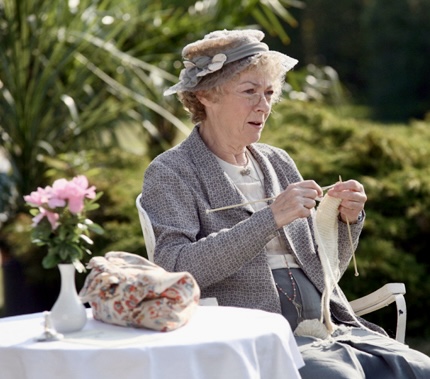
Fact: Old Ladies Solve Murders

Agatha Christie was right, old ladies make great detectives. Spies not so much with all the shooting and chasing. But great detectives and not for the reason one might think. AI may be threatening to take over the world. And I will admit I’ve seen some campaign commercials here in LA lately that absolutely speak to the brilliance and benefit of AI. Yet, sometimes things can’t be duplicated, even by great tech.

So how do old people beat AI? Oh sure there is wisdom that accompanies age, but it’s more. The skills it takes to be a detective are not the only advantage aging brings. It is the hard and extremely cold fact that old ladies are invisible. They can travel about unnoticed as they check out the clues quietly summing up the scene.

Now of course some are better than others.

However, there is a common denominator as they all live in small towns or villages, if you’re in England.

Yes, New York would be hard to navigate, although Jessica Fletcher did venture out of Cabot Cove occasionally.

However, the cases always involved someone in close proximity to her. A relative or neighbor.

Even Miss Marple couldn’t know everyone in New York. Nor I imagine would she want to. But that’s a blog for another day.

So what is it about older ladies, especially widows that seem to hone their investigative skills?

First and foremost, I imagine it’s because they are quiet. They listen and pay attention to details. So when a murderer is spouting a piece of evidence that directly links them to the crime, they actually hear and absorb that knowledge.

Unlike younger people that are so engrossed in social media they hear nothing. Save of course the blare of loud music or pings that signify a text has just come into their phone.

Older women also have years of watching people speak. They have developed a sixth sense about those who are lying, skirting the truth and avoiding the question.

Good information if you’re looking for a murderer.

They are also smart and know the questions to ask. For example. Someone in her village has come to enjoy a cup of tea.
Knitting needles come out, but this is merely a ruse because Miss Marple already has a plan. She has a list of questions she will inconspicuously ask to discern if the person is the murderer.

Yes, it’s just that easy apparently, to figure it all out. Sadly, the police are usually the last to know.

So she has poured the tea, offered the biscuits. And no, I have no idea why the British call cookies biscuits, another one of their supposedly charming quirks I imagine. Despite how heinous the killing, there is always time for tea.

The killer couldn’t be more at ease. Unsuspecting while sipping and munching in a haze of comfort around who they believe is someone totally harmless.

So as with anyone in that position, the guard is let down and a killer tends to slip up and let out a potential clue.

Aha! Marple attacks ever so cleverly. Knit one, purl two, knit one. “So, how are your hydrangeas doing?”

“Oh thank you for asking. They are much better now that you told me to use that special mix. They seem to be thriving. How did you figure that out?”

“Just something my mother used to do to help her garden when it seemed tired. Did you get the mulch at the florist I sent you to? He seems to have just the right mix to make the formula work?”

“Yes, I went there as you suggested.”

Marple is no fool and this was nothing about mulch of course. She is well aware the florist is closed for the month and on vacation with his family at the shore. Aha! She has uncovered a lie. So much for that alibi.

Now Marple must unearth the reason for this deception. Although she is already highly suspicious.

She backs off a tad knowing that after a lie, the killer will be a bit on guard.

“Did you hear the schoolmaster has accepted the job in Cornwall?”  She inquires ever so innocently.

“Yes, what a loss. I had him in first form when I was eleven. Such a wonderful man. A great loss for the entire village.”

Excellent, the killer is back at ease.

Marple strikes again.

“I should wonder they’ll have trouble finding a replacement. After all, one of those who would be considered was the victim in that dreadful murder.”

Marple looks up from under her specs and studies the killer’s reaction.

The killer flinches noticeably. She catches herself quickly, but not fast enough for Marple to have learned all she needs to know. She has determined the person she is with is guilty.

After a few other pointed questions Marple has what she needs to offer that murderer up on a bone china biscuit plate.

And she does so with humility and relish. Although inside of course she is aware she is much smarter than the authorities and can run circles around their skills any day of the week.

Yet she is nothing if not generous and humble. She wants the police to praise her skills and appreciate her help.

And although they consider her an old busy body, they are forced to admit, she’s got the goods.

The method and the ending never vary. Oh the murderer and victim may change, but Marple’s methods remain the same. Tea, biscuits, knitting needles and a few pointed questions then Bob’s your uncle.

Another case solved in one or two hours.

Only Agatha Christie could create a Miss Marple, because she was her in every way. A woman who understood the value of paying attention to details.

I suppose that’s why to this day people still love, read and reread her novels, watch her movies and refer to her as the undisputed Queen of Mystery.

Christie is a master of understatement and suspense. Unequaled in her ability to craft a convoluted mystery in a clever and interesting manner.

Guessing along and figuring out the killer is a source of pride for any mystery lover, and more reassurance the greats always do it best.

Brilliant? yes. An unassuming woman? Indeed.

Still the greatest of all time? You bet, and AI can put that in their pipe and smoke it. Knitting needles and all.

The City That Never Sleeps Or is That Should be Put to Sleep?

“It couldn’t have happened anywhere but in little old New York.” O Henry

As story and recollection go it was merely an accident that my father left my mother on the New York State Thruway rest stop gas station at two in the morning. As I am the only one left to remember I assure you I have thought carefully about this incident over the years. Partly to ensure it is not forgotten and partly to discern its intention.

Long ago content my father was merely not aware my mother had stepped out of the car from resting in the back of the station wagon with my brother and I, the subject was a source of humor.

Now I’m not so sure. About the intent I mean. As I grew older and my Freudian radar increased, the fact it was a simple mistake by an exhausted driver no longer rings as true.

Were it not for the truth of my parent’s marriage that stares me in the face, I could put the matter to rest. Like a dead squirrel on the side of the road, or thruway as the case may be.

I was asleep in the back of the new chevy station wagon when I awoke after my father asked loudly if my mother was there. “No,” I answered sleepily and suddenly felt the brakes slam on and a sudden charge of the car backward.

My father apparently realized my mother wasn’t sleeping and began the process of backing up on the thruway on ramp for what seemed miles.

So surprised, I was speechless until I saw my mother standing at the gas pump. Braless and almost barefoot, clothed only in shorts and a blouse whose buttons were struggling to cover my mother’s ponderous breasts.

I can’t remember if anything was said when she reentered the car. In fact, probably nothing was said for quite a while.  We’re talking days here, folks. I do remember my mother muttering something about the gas station attendant thinking she was a whore, but of course I didn’t even understand the word at that age. Yes, I know hard to believe we were so naive back in the day, isn’t it?

Of course, my father struggled to explain he was unaware she’d left the car for the ladies room while he paid the bill, and well it was all rather understandable really.

But was it? Or just an unconscious attempt by my father to take advantage of a rare opportunity to free himself? Lord knows the man dreamed and talked about it his entire life. Escaping from my mother I mean. So, the possibility of such an achievement must have been enticing.

Although knowing my father as I did, it seems quite unlikely he’d ever have been able to carry out such a feat.

I always attributed the incident to simply the icing on a disaster cake that was our trip to New York in the fifties. It began with my father telling my eight-year-old brother to wait for him in the doorway of the Astor Hotel while he bought something in the gift shop.

My brother wandered away looking for him and chose the wrong door of the two that led outside. Yep, seems my Dad wasn’t as tuned in as he should have been that trip.

After police and house detectives began a search for him it all felt exciting, like a real life TV detective show. I was far too young to comprehend the gravity of the situation then, but today it still haunts me. We received word the police had found a boy wandering the streets alone and taken him to the station. He was served an ice cream cone. Yes, that was the New York City police ladies and gentlemen, back during civilization. He was returned to us, scared, anxious, but well fed.

That evening my father and I saw The Music Man on Broadway which was great. At least until we entered Sardi’s restaurant where they wouldn’t let my father in without a suit jacket. They offered up a beige rag of a frock which he donned before sitting. Then we both sat embarrassed and unhappy during the overpriced meal.

Sardi’s food has become even more overpriced now and the dress code far less English Royal Court, but the memory lingers on. I did go back there once many years later, but the food was still seasoned with mortification and sadness for my Dad. Sadly, a reputed restaurant a child was so excited to try, offered up a menu that included an understanding of the word humiliation.

By now you’re probably wondering if I ever returned to New York. Yes, I did on numerous occasions, but I’d be lying if I told you any of those trips ever made up for or even came close to that time, which still burns in my brain.

When I think of New York my memory immediately plays mental pictures of my mother standing frightened at the gas pump and my brother crying. Of a rude maître d holding a schmatta jacket accompanied by a desire to never return and experience those feelings again. And yes, there were happy moments on that trip, but sadly I guess the image of a Big Apple with a worm inside remains.

The words written to laud NYC are plentiful, but perhaps New York really is as Ralph Waldo Emerson described it…”a sucked orange.”