
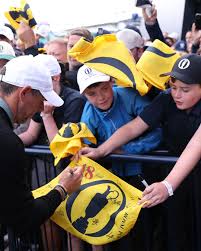
I can’t play golf to save my life. Yet I can watch it all day. I have no idea why the sport seems to draw me in like a piece of Black Forest Torte, but I am mesmerized watching someone use a stick to hit a ball into orbit and land in a tiny hole.
I imagine it’s partly because I grew up watching my father watch the greats. Palmer, Nickolas, Player, Weiskopf, Hogan, Tiger and on and on. So those memories probably have a great deal to do with my fondness for the game.
Having said that, this isn’t so much about the game, as the players. I find it very interesting to see the enormous difference in the ways players approach their fans.
To me it’s truly disappointing seeing young kids excitedly awaiting a fist bump from their idol as he walks by and then ignores them. Nothing is so sad as a disappointed look on a kid’s face.
Of course, I’m aware that each player has their own way of dealing with game stress. Some are laser focused and crawl into their head. What I call the Meryl Streep method. She is notorious for never breaking character, even when the cameras aren’t rolling. If that’s their method of dealing I would never criticize. Sometimes the players will be stoic walking by fans, then later in the game they interact. I suppose it’s about how each is feeling about their game at that moment.
Then there is the I-love-the-fans player. Tony Finau always impresses me when he stops and greets the fans. He signs their caps and chats. Takes time to give someone a smile that costs nothing and is so valuable. I know watching the interactions they are moments that will stay with these kids forever. He’s a true mench. And yes, I know menchiness doesn’t create a birdie. Or does it?
Bryson De Chambeau also attends to the fans and often practically makes them a part of his game. Although he is a controversial figure, since signing on with LIV golf he has become far more fan friendly and accessible. Bryson also engages with fans on social media.
So does it add? To their scores I mean.
Honestly, I haven’t done a study. Yet I am a firm believer in bad juju.
Does every sad look on a fan’s face, especially kids, take just a bit off the positive energy you need to cross that line between winner and loser?
Or are juju, vibes or karma just notions that don’t exist? Just part of the fairy tale we tell ourselves to explain away failures and rationalize surprising defeats?
Does fan interaction translate to champion status?
Some of the players with a reputation for great fan friendliness are also great champions.
The great Arnold Palmer is the pioneer of fan interaction. His charisma created “Arnie’s Army,” a following of dedicated fans that created today’s personal connection between golfers and spectators. Akshay Bhatia has even noted how much the support from “Arnie’s Army,” has meant to him and how he enjoys having fans cheer for him.
Rickie Fowler is approachable and his colorful style and social media connection with fans has made him a favorite. Jordan Spieth is also known for his grounded and fan-friendly approach.
Golf great Jack Nicklaus is a genuine fan ambassador who is approachable and became kinder to fans later in his career. Jack Nicklaus is highly praised for his work as a humanitarian.
However, Tiger Woods blows my karma theory to bits. Although he eventually became the most popular golfer of all time, fans and media criticized Woods for his poor temper, swearing on the course and often showing irritation with fans.
Bubba Watson had a reputation for emotional volatility. His demeanor has been called “gruff” and difficult to be around.
So does the way a player acts around his fans and on the course define him? Is it a predictor of success? I imagine Tiger is an example of the flaws in that theory.
Yet, golf has always been known as a gentlemen’s game. And yes, I know the age of manners is long gone. Yet is winning the game all there is to golf?
Every sport has its nice guys and jerks. As do fans.
Do fans sometimes go overboard and become nasty and overbearing? Yes, at times. Are we all human after all? Yes indeed.
It’s often a two way street. Many players have criticized fans for becoming too rowdy and aggressive. Rory McIlroy labeled some fan behavior “unacceptable” after he and his wife were abused during the 2025 Ryder Cup.
As a kid I loved attending the Tiger games at the old Brigg’s Stadium in Detroit. That was when there was actually the smell of freshly mown grass as part of the game.
Rocky Colavito, one of my favorite Tigers was widely regarded as a very nice, likable, and charismatic person, often described as a gentleman who loved his fans. He was beloved for being accessible, not drinking or smoking, and consistently signing autographs for children because of his own childhood memories.
Al Kaline was known to be a fan favorite. Yet my own experience with him was quite the opposite. Kaline was a neighbor and one Halloween when I took my younger brother trick or treating, we wound up at his door. His wife answered and I nicely asked if it would be okay if Kaline signed an autograph for my brother. She became annoyed and left the door returning with a signature on a torn off piece of paper. Familiar with Al’s autograph I knew it wasn’t his. I said nothing and thanked her. My brother left without an autograph and I left as living proof of the old adage: You should never meet your heroes.
Okay so I’ll give Kaline a pass and say maybe his wife was in a “mood.” Perhaps he would have been nice had he answered the door that night, but he didn’t and she did and it left my brother and I without a great memory of a baseball legend. Did it matter? Did it change anyone’s life. No, not at all.
Maybe these young kids who look up to the Scottie Schefflers, Tigers and Rorys might see a fist bump, an autograph or a hello as something inspiring to cherish. Perhaps even to use when they need a boost and that signed cap from a hero can make the difference in their own golf score.
So do the fans change a player’s game? Probably not at all. Can they provide the bad juju at times? Sure. Still, there is something to be said for positive energy. The old home court advantage thing, isn’t about property as much as emotion. Love spreads while indifference goes nowhere. An act of kindness is always a positive addition to any athlete’s game and if it isn’t, well good vibes can ultimately spread and land somewhere you’d never anticipate. Maybe even back on you when least expected.


