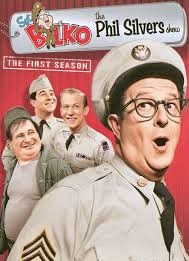
Sgt. Bilko, Lucy and the Greats Still Reign Supreme on Laughter Scale

Starting off the new year with a laugh is important. It sets the tone for the entire year. Sort of a barometer for the chuckle degree of the upcoming 365 days.

Humor has undoubtedly changed in this new world yet some things are and will always be funny.

They survive the ages and remain relatable.

Old sitcoms that relied on the tried-and-true formulas that guaranteed laughter succeeded best. And still do.

To this day there are certain moments I recall and can’t help breaking into laughter. No matter how many times I’ve watched them.

There are many legendary laugh sequences in the old shows that hold up, no matter how many years pass.

One of the tops on my list would be the Harry Speakup episode of Sgt. Bilko. Phil Silvers’ character remains one the most unique and brilliant comedy inventions of the era.

All the episodes delivered laughs, but the one that has stayed with me the longest is when they drafted a monkey into the army. Even now it’s a bright spark of comedy genius in the humor solar system.

Zippy the monkey being hurried along the draft assembly line brought a constant barrage of laughter. From the interview with the psychiatrist to the foot inspection, it was pure hilarity. The episode combined the brilliance of a great storyline, a universal theme and expertly written comedy that quite simply defies gravity and time.

The Dick Van Dyke Show episode when Rob was convinced he’d brought the wrong baby home from the hospital is pure comedy gold. Van Dyke opened the door to find the suspected father of their son Ritchie to be Greg Morris, a popular African American actor standing there. That moment elicits one of the longest laughs in sit com history. They had to edit the laugh because it went on so long. Carl Reiner was a master at leading us down the comedy garden path and surprising us at the end of the trail.  The show delivered great lines like Laura’s constant, “Oh, Rob” or Alan Brady’s “Shut up, Mel.”

I don’t believe anyone on Planet Earth could argue that I Love Lucy has withstood the test of time.

From the Vitametavegimen episode when Lucy gets drunk while shooting the advertisement, to the candy factory when she and Ethel are shoving chocolates into their mouths. The show has continued to bring laughter to every generation around the world, despite its age.

There are so many moments that still bring a smile it would be almost impossible to list them all. Yet three that still remain etched in my memory are Lucy setting William Holden’s nose on fire, stealing John Wayne’s footprints and dressing up a salami as a baby to carry on the plane.

I would be remiss if I failed to mention Milton Berle, AKA Uncle Miltie dressed up as a woman. I guess you could say he was the first drag queen on television. His ability to laugh at himself and carry off a Carman Miranda bowl of fruit on his head was hilarious, and definitely holds up.

Watching Barney Fyfe trying to unholster a gun, Sammy Davis Jr. kissing Archie Bunker, Betty White’s Great Herring War story on Golden Girls or any St. Olaf story. How can we ever forget Carol Burnett dressed in the green velvet curtains in the Gone with the Wind sketch, or Tim Conway breaking Harvey Korman up playing a dentist? Or breaking him up in every bit?

Another great TV moment was in WKRP in Cincinnati. Station owner Arthur Carlson had turkeys dropped out of a helicopter for publicity and discovered the hard way turkeys can’t fly. His iconic confession after the turkey disaster, “As God is my witness, I thought turkeys could fly,”

Chuckles funeral on Mary Tyler Moore when Mary loses it completely. Sue Ann Nivens or Ted Knight, two characters that never failed to elicit laughter. Mary definitely delivered the laughs. Ed Asner as Lou Grant bragging about how fair a boss he was, “If I don’t like you, I’ll fire you. If you don’t like me, I’ll fire you.”

Seinfeld always delivered the goods, sometimes simply by Kramer entering the room. George Costanza saving the whale or Soup Nazi and who could forget the astronaut pen, the manbro or Festivus?  “Yada Yada Yada, “No Soup For, You,” “Serenity Now,” “Hello, Newman,” or “Master of My Domain.” Truthfully, pretty much every moment on Seinfeld was hysterical and it would be almost impossible to list them all.

Friends also delivered shows and lines that have become part of the culture. Phoebe singing Smelly Cat, Ross yelling “We were on a Break,” or mistakenly saying Rachel’s name at his wedding. Joey and Monica with a turkey on their heads or Joey just eating. Chandler advising Joey, “You have to stop the Q-tip when there’s resistance.” Joey’s “How You Doin,” Monica yelling, “I KNOW!” or Janice’s laugh.

Comedy icon Garry Shandling demonstrating the Garden Weasel or Hank Kingston’s “Hey Now” on HBO’s groundbreaking The Larry Sanders Show.

The duck falling down from the ceiling dressed as Groucho? Or Groucho Marx just being Groucho on You Bet Your Life.

No, I didn’t forget Ralph Kramden on The Honeymooners threatening to send Alice to the moon. Or Art Carney attempting golf and addressing the ball. “Hello Ball.” Jackie, AKA the Great Gleason, knew how to do comedy.

The wonderful part of recalling all these exceptional comedy moments is the assurance they can be watched again on reruns or, in a pinch, YouTube.

I know there are many more you thought of while reading and feel free to remind us all by commenting on my blog. I’m sure the more comedy moments the better for us all.

Yes, there is much to be concerned about entering 2026, but there is also much to celebrate.

What better way to escape the craziness than to watch a favorite sitcom and keep the hilarity coming?

Happy New Year, everyone. I hope it’s your best and most laugh-filled year ever.

I Dream of Life Inside Jeannie’s Bottle

Does art imitate life or vice versa. It might be either. Do I believe that? Is art the driver of life or merely a reflection? I actually believe it’s both.

Art will push the boundaries of what’s acceptable and at times use imitation as creation.

Fifties and sixties television is a perfect example.

The norm at the time was women in the home. Men ruled the roost and women cooked the roast.

TV perpetuated these stereotypes with gusto.

Fifties Moms were portrayed as neat, well dressed, always coifed and able to perform their duties.

They kept a clean house, cooked healthy meals always adhering to the food pyramid, and considered their husbands the authority on the world outside the home.

Each lived and existed within their domain.

Fifties women were no more than updated cavewomen who cooked the game hubby provided and kept the cave clean and tidy.

I remember a Donna Reed show where there was a plumbing problem.

Her husband was busy so he couldn’t get around to the issue quickly enough to suit her. Donna Reed actually took it upon herself to call a plumber and deal with the leak.

When her husband learned she had “handled” the problem he was surprised. So complimentary that she had stepped out of her comfort zone to deal with a man’s job.

WOW. Can you imagine. A fifties Mom actually made a phone call to a plumber? How incredibly bold and modern of her. What will women accomplish next?

There were specific attitudes that not only reflected the times, but embraced and exploited them.

Samantha wasn’t allowed to be herself and took scolding after scolding from stupid Darrin if she dared use her magic powers. Unless of course they suited his needs.

Don’t even start me on a half-dressed Jeannie in that bottle. Can you say, every man’s fantasy? And she called Larry Hagman Master. Subtle? I think not.

Ozzie and Harriet even kept the father at home so he could be on-site overlord. No one ever seemed to ask or care how Ozzie paid the bills while he sat around in his cardigan sweater.

Father Knows Best is so obvious need I say more?

Even westerns were in on the joke. Cowboy shoots up the town, sheriff arrests badman and saves the women and children.

Yes, we knew the rules and the playbook, and although we grew slightly uncomfortable with it, we didn’t make waves. At least not yet.

TV and movies of the day were much the same except movies tended to push the envelope. They could because they weren’t entering your home.

If you wanted to see a racy movie like The Best of Everything, you went out and paid. And one of the reasons it was considered “racy” was it featured women working in a man’s world and alluded to sex. Tsk Tsk how revolutionary.

Movies could change mores, but Doris Day is proof that didn’t happen as much as was necessary. In the movie The Thrill of it All with James Garner, Doris is offered a position to be the face of a soap company.

Garner was upset because she wasn’t home to greet him at night like a tail-wagging cocker spaniel. He devised a plan to get her pregnant so she’d have to quit and stay home. Seriously?

Yes, men in movies could be portrayed as buffoons and television did begin to allow some to be portrayed that way. But always in a comic way.

Hello, Barney Fyfe. But Andy, who was a father, was the responsible and mature one of the pair. Always ready with sage advice for Opie and an endless supply of patience for Barney’s shenanigans.

Yes, there were certain expectations and no one complained much. Until they did.

As women began to explore life outside of the home television began reflecting more women at work.

The seventies had programs about policewomen, executives and bosses instead of just secretaries and housewives.  

The women’s movement effected not only the times, but the entertainment.

Women could be strong, bold and dynamic. It became no shock to anyone anymore that we were capable of calling a plumber to fix a leak. Or that fathers knew best only because Moms usually let them think that was true.

Art has never been fully aware of how much it affects the norms.

After a lifetime of watching television, going to movies and absorbing the intake, I see things clearly.

Yes, art imitates life, but it also seals the norms place in society.

No, viewers do not run out after seeing a cop show and rob a bank or become violent felons.

However, it does have negative impacts on the world.

By bombarding viewers with violence, crime and horrible people, the shock value wears off quickly.

Shock value is an important element in that it draws a line in the sand between what is acceptable and what is absolutely not.

The more we become accustomed to seeing evil, the more accepting of it we become.

Like a comic who uses the F-bomb over and over and it eventually loses its meaning.

No one is surprised anymore that politicians lie, in fact we expect them too.

Society is no longer shocked or shaking their heads by crime and violence. After all nothing could scare us as much as the evening news.

It’s as if we’ve come to expect the worst. And learned to live with it.

Can we blame this on television when network execs did fight valiantly to keep Mom home and Dad believing he was king of his domain?

Or was it inevitable that after seeing so much brutality in movies and on television we became too blasé about it.

That Clint Eastwood as Dirty Harry became entertainment instead of a warning of cities turning into future war zones?

We’ve learned to tolerate evil because it was so easily allowed into our world. Crime, violence, harsh language, corruption and dishonesty are almost expected as part of the genre.

Perhaps we were just kidding ourselves all along. Buying the fairy tale that as long as Donna Reed was in her high heels and pearls stirring oatmeal, and Ozzie was in his cardigan chatting with Thorney, all was right with the world?

Or was art just a reflection of a world that changed so quickly we never saw it coming. One we had no desire to accept into our lives.

No wonder people watch reruns of the old shows and sigh at how uncomplicated life was then. All problems could be solved in half an hour.

Jeannie’s bottle sounds like a pretty good hiding place to me now. Move over Barbara, and could you teach me how to nod your head and conjure up dinner, please.